
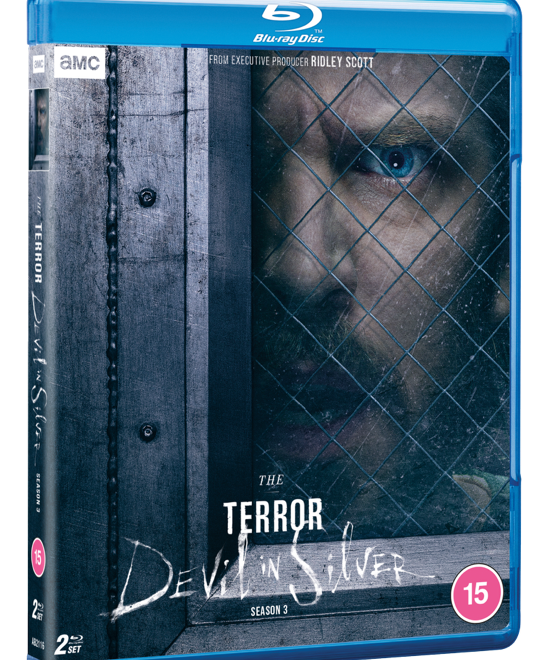
For the third season of the prestige horror-drama anthology The Terror, AMC have opted for an adaptation of Victor LaValle’s novel Devil in Silver, a contemporary story that takes place in a New York mental hospital whose sinister techniques and arbitrary rules seem to harken back to a darker age of mental health treatments, invoking One Flew Over the Cuckoo’s Nest and the mid-century fad for lobotomies. Meanwhile, what’s behind the forbidden silver door? Is it, as some of the patients seem to believe, the Devil himself? If you remember the boogeymen of The Terror season 1 and its second season, The Terror: Infamy, you may guess where this is going.
It’s not a bracingly original story, but it’s told fairly well in this shortened season of 6 episodes. The dependable Brit actor Dan Stevens plays the lead rôle, Pepper, with an admirable lack of ego, for Pepper is a total loser; a hothead, an egotist, a deadbeat and yet, for all that, with something in him that makes us root for him – even if Stevens ends up really overdoing the American accent, probably to make up for a lack of confidence in mastering it (Stevens has played Americans in many Hollywood productions, but not necessarily with 100% conviction).
Elsewhere the cast is filled up with talented character actors, including Judith Light (Transparent, The Menu, The Punisher: One Last Kill) as a fellow inmate and perhaps the most nuanced character depicted herein; Stephen Root (Office Space, Red State, various Coen Brothers projects) Marin Ireland (Sneaky Pete, Hell or High Water, The Umbrella Academy) in a bit part as a cop; and CCH Pounder (The Shield, the Avatar sequels, Amanda Waller in various DC Comics adaptations) doing a light Caribbean accent as the chief psychiatric nurse. Perhaps best of all though is Aasif Mandvi, who plays the rather pathetic, put-upon head doctor/administrator. I had to look up Mandvi, but he brings a long background in comedy to a part which he builds into a surprisingly sympathetic and complex character from a fairly minimal characterisation on paper.
On paper, in fact, none of the characters here would be nearly as interesting as the uniformly excellent casting makes them. I haven’t read LaValle’s novel, and this season of The Terror doesn’t make me likely to – even though I consider it a good piece of television. It’s good, but not great; it’s much better than it deserves to be for something with a premise this hackneyed in horror. The original The Terror, back in 2018, was for my money one of the greatest television miniseries ever put out, with fascinatingly complex characters, an instantly intriguing premise that you hadn’t seen before, and an oppressive atmosphere all its own. Having excellent source material in the form of Dan Simmons’ novel The Terror probably helped too, but naturally no miniseries that excellent could be left as just a miniseries, and so producers have found two more stories with a couple of the same elements as that original series and grafted them on so they can benefit from name recognition: The Terror: Infamy was an original story that featured a historical setting, institutionalised characters (Japanese-Americans interned during WWII), and a setting with no escape from a supernatural monster; The Terror: Devil in Silver is contemporary but is adapted from a respected horror novel, features institutionalised characters, and a setting with no escape from a supernatural monster. These recurring ingredients, I will say, are useful ones in horror, but these tropes become predictable especially if you watch all three seasons in a row. If you’ve never seen The Terror‘s first season, by all means watch it; you owe it to yourself. The dull second season and the decent-but-underwhelming second season do have aspects to recommend them, but they’re not essential viewing; if you wish to draw an analogy in your head with True Detective, go ahead.