
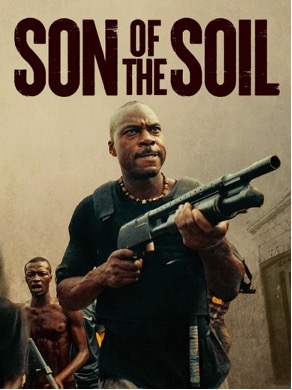
We recently spoke to Razaaq Adoti, writer, co-producer and star of the Nigeria-shot action thriller Son of the Soil…
Thanks for joining us. First of all, do you want to give our readers an idea of Son of the Soil and where it came from?
Yeah, it’s a story about this Nigerian soldier who was dishonourably dicharged – he got into a physical altercation with his sister’s ex-boyfriend who was being, shall we say, less than chivalrous. And so he got kicked out of the army after spending some time in military prison. On his release, he got an opportunity to work in the States, so he jumped ship and worked there for a while. He was really hurt by the way the military treated him, so he decided to make a career and a life for himself overseas. He doesn’t really intend to stay out there that long, but a decade passes and he gets a phone call: “Hey, look, your sister’s died of an overdose”. So he rushes back to Nigeria, where he discovers that she didn’t just die, she was murdered – the overdose thing was a cover story. And, on top of that, his once-idyllic hometown has been overrun by drug dealers selling a new form of fentanyl on the street, Matrix. He finds himself a reluctant hero; he’s now got to not only solve who killed his sister and why, but he also finds himself left with the responsibility of cleaning up his hometown and throwing out the drug dealers.
I like to think of it as more of a story of redemption than revenge. It came about through discussions I had with the director and co-producer Chee Keong Cheung, who I worked with on The Experiment, a film coming out later next year. He had an interest in the Nigerian film industry, and he’d been aware that Nollywood was one of the top three film-producing regions of the last couple of decades. And with Afrobeats blowing up everywhere, there’s more of a focus now on Nigeria – people are realising, here’s this massive population and massive diaspora to tap into. And I was happy to do that as a Nigerian, born in London. It was a beautiful opportunity to go back to the land of my heritage and create art there with all the amazing artists that we came across.
So the script was always designed to be a Nigerian story and a Nigerian production?
Absolutely. And even more so, it was devised to be an action movie. I’d written a few scripts before but never an out-an-out action film, so it was a bit of a departure for me. I was always adamant that I needed a really solid story, not just an excuse to go from one fight to another. And I didn’t want it to be one guy who comes in from overseas and just beats up Nigeria, you know what I mean? There had to be more to it in terms of his motivations, his vulnerability, and his weaknesses as well. Once he understands what it is he’s walked into, he has to join with the community – it’s a communal effort, righting these wrongs.
It’s an interesting film politically. A lot of Hollywood productions have a kind of imperialist subtext and Son of the Soil is the opposite, but it still has the pace and the tone of Hollywood action.
Yeah, that’s the thing. Someone wrote an article about it that I liked, calling it a throwback to 80s action romps. I thought, “I can live with that”. There is obviously action all the way through. But as I said, that action means nothing unless there’s a reason for it. As you see in the film, he’s a victim himself in many ways, from what happens to his sister, to himself being physically attacked when he sticks his nose in too deep and too quickly into situations he doesn’t know enough about. And there are other family members who have situations of their own that I won’t get into, as well as the young street girl that he meets.
You have to ask yourself, “Okay, what could drive me to that point? What would have to happen in my life?” And I want the audience to ask themselves that, too. They might not necessarily make the choices Zion does, but for sure they can understand why he made those choices. As long as you’ve done that, the situation is feasible – no matter what happens next, all the craziness and gunplay and the fights and bloodshed and chases and this and that, they all make sense because we have the gravity of that initial inciting incident. And not only does he have good reason to do what he did, he joins with the community in finding that solution. He leaves the place in a better situation than when he arrives, like a very ugly superhero. It’s very much in the gutter, and visceral and ugly at times, but it’s from a place of love and wanting to heal. I think that’s what people respond to.
Were you always in the frame to star? From day one of writing, were you writing lines for yourself?
Yes and no. I did know I was going to star in the film, we’d discussed that already. But it’s really weird, man. I wasn’t writing it thinking, “OK, this is me”. I really just wrote the story for the story. I think I stayed true to that, because there are a lot of characters orbiting the main character that I actually prefer. A lot of those were based on real people from my trips to Nigeria. From hanging out with my cousin, Tsunde – he’s a character himself and he has a lot of crazy friends with crazy names, like Wanderer, Diallo…I’ve taken certain character traits from them; even the main bad guy’s name, Shaka Bulla. Shaka Bulla is a homemade gun; not a 3D-printed one, literally homemade. That was perfect for the character because he’s self-made, he’s homemade, and he is himself a weapon. And without the reality of these people existing, I wouldn’t have had that source material to draw upon.
I think I enjoyed that more so than just writing Zion, because as a central figure he’s very stoic and introspective, he has a lot of thoughts going on that he can’t always express, and he has no-one to express those thoughts to. He’s not going to say it to his mother, he’s not going to say it to the little girl either. But the other characters can be free about who they are and what they want. That was a lot of fun to write.
It looks fun. It looks like the cast are having fun.
Yeah, we did. We had a blast. We didn’t have a tremendous amount of time to shoot, or money, but the story was like a tidal wave that kept us moving forward. We didn’t stop to breathe throughout. I think we had one day off, a Sunday. Other than that it was, boom, boom, boom. Also, a lot of what we shot was people from the local community, passers-by, or shop owners – we’d just ask, “We’d like to shoot in front of your shop, is that OK?” Of course, people are getting paid, but they’re happy to be in scenes and go about their business. We had people literally coming in and buying things in the middle of shooting. We’d be doing a scene and life would be going on. Life finds a way, right?
Was that your first time shooting in Nigeria?
No, I’d shot a couple of things there before, but always other people’s things, nothing of my own. And they were very different productions. One of them was pretty much all interiors, the other had some outdoor scenes but it wasn’t like this, shooting in the middle of the city, like – “here’s your camera, here’s your cast, here’s your script, shoot”.
More generally: you’ve played in Black Hawk Down, Doom, a Resident Evil movie – what role do you find fans and journalists go back to the most?
Man…that’s an interesting one. Definitely the ones you mentioned. Amistad comes up quite a bit – working with Spielberg is a big one. But in Nigeria, what comes up the most is the two films I did with Jean-Claude Van Damme. Again, they love action movies over there.
So what’s next for you?
I’ve written a film that I’m also producing, Base Human, a crazy futuristic sci-fi movie, also set in Africa. It’s something that’s not really been done before, very different to, say, Black Panther. In fact I wrote it before Black Panther, but where Black Panther takes place within the Marvel Universe, this is more like how Nigeria would look 70 years from now, very gritty and with the same energy we had in Son of the Soil: people on the street selling stuff, people yelling, bus conductors and that…I feel like, generally speaking, when it comes to space, both in fiction and in the real world, Africa is never in the conversation. Even though the majority of African nations do have satellites in orbit – it’s mainly telecommunications, but most of those countries do have space programmes. So I wanted to look into how that might look, this futuristic Lagosian world as opposed to the images we’re often bombarded with, especially in the West. We’re actually using Jack Thompson Rylance again, who was the cinematographer on Son of the Soil. He did an amazing job, literally put his body on the line.
And will we ever see a Son of the Soil 2?
I hope so. But you know how these things are, it depends ultimately on how people receive it, I’m none the wiser at this point than you are. But I do have some interesting ideas for how to move the story forward. We’ll see what happens.