
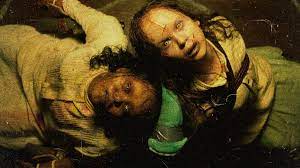
Happy Halloween! I’m sorry it’s over. But not as sorry as I was when I realised I’d paid good money to spend Halloween night watching The Exorcist: Believer, the utterly conventional re-quel to the film that put the fear of God into credulous 1970s audiences.
Now, the original Exorcist is not the scariest film ever made, and don’t let any silly busybody tell you that it is. Historical hype has, at this point, likely obscured its actual virtues, namely: it’s an intelligent film; it’s got a feeling of verisimilitude to it, from William Friedkin’s documentary-style direction, to the believably terrified performances of veterans (Ellen Burstyn, Max von Sydow) and then-amateurs (Linda Blair, playwright Jason Miller, actual priest William O’Malley) alike; it’s very restrained all the way up to its final reel; and it’s a serious exploration of faith by a Catholic writer (more on this later).
You have to wonder, though, how much any of this mattered to the producers of The Exorcist: Believer, who likely just realised that they had a recognisable name to exploit. How many audiences have really seen The Exorcist at this point, and how many just recognise the opening bars of Tubular Bells, that great shot of the spooky steps, and the bits they might’ve seen parodied in Scary Movie 2, A Haunted House, A Haunted House 2, Saturday Night Live, Key & Peele, The Simpsons, or the Linda Blair-starring Repossessed?
David Gordon Green’s Exorcist: Believer takes largely the same approach to its source material as his 2018 re-quel Halloween, though thankfully it at least uses a different title from the original work. All previous sequels and prequels are ignored and the mood, structure, and a number of key memorable scenes from the original are slavishly recreated for audiences not necessarily familiar with the original. Meanwhile, to keep longtime fans happy, key actors are brought back in spite of their nonagenarian status: meaningfully, in the case of Jamie Lee Curtis reprising Laurie Strode; utterly pointlessly, in the case of Ellen Burstyn and Linda Blair, the latter of whom has one line. Count ’em! Wait, you can’t. You can’t really call counting to one counting, can you?
While all horror franchises ultimately become nothing more than homogenised Hollywood product, regardless of whether the original work is a “greatest of all time”-type film (see: Dracula, Frankenstein, Psycho, Night of the Living Dead, The Texas Chain Saw Massacre, Jaws, Halloween, The Silence of the Lambs), it’s particularly sad to see The Exorcist succumb to the inevitability of mediocrity, after fifty years of fascinating, if not always good, films. It’s puzzling that The Exorcist, which seemingly provides a fairly simple formula, one reused in the Turkish Seytan, the blaxploitation vehicle Abby, the tasteless “true-life” story The Exorcism of Emily Rose, and so on, seemed so impossible for its creators to crack. Perhaps those “curse” rumours were true all along. John Boorman’s Exorcist II: The Heretic offered the return of Linda Blair, joined by Richard Burton, James Earl Jones and Nurse Ratched, in a futuristic and confusing story of great good, ultimate evil, and the impending psychic revolution of humanity, but failed to win over audiences and made many critics’ “worst-ever” lists. The Exorcist III, directed by original writer William Peter Blatty from his novel Legion, is barely related to The Exorcist save for the presence of three returning characters (two of them recast, one of them playing a sort of zombie or revenant), in another confusing and somewhat unhinged tale, this time a cracked police procedural involving the possible resurrection of the Zodiac-like “Gemini killer”. Oh, and eventually there’s an exorcism. But, not yet finished being wild, the franchise next turned to writer and occasional director Paul Schrader (Taxi Driver, Raging Bull, Mishima: A Life in Four Chapters) to deliver a prequel. This prequel is heavy on Blatty’s signature themes of faith, doubt, evil and redemption, wrapping them around a tale of intrigue and intolerance as a young, temporarily faithless Father Merrin has his first encounter with evil at a dig site in British Kenya. The film was slow, thoughtful and weighty, and the studio hated it, bringing in Die Harder and Deep Blue Sea director Renny Harlin to reshoot 99% of the film, with half of the characters recast, and an entirely new script, but one which tells almost the same story, just with different, dumbed-down dialogue. It’s one of the most bizarre decisions a major studio has made, only out-weirded by the fact that, in the wake of hostile reactions to Renny Harlin’s film (Exorcist: The Beginning), the studio decided to release Schrader’s original prequel (the clumsily-titled Dominion: Prequel to The Exorcist) anyway, a year later, to a somewhat more favourable reaction. I strongly recommend watching these two films in close proximity to one another. It’s a bizarre experience, it’s like watching two different adaptations of the same novel, but without the novel.
All this is to say that, while every previous Exorcist followup has been a mess, they’ve all been glorious messes, each of them distinctly the work of their respective creators, and I wouldn’t have it any other way. I also happen to personally quite like both The Heretic and Dominion, despite their reputations, as well as III which is generally looked on less harshly. So it’s a profoundly tedious experience to sit through Believer, which is slickly-made, competent, tells a mostly coherent story, and makes perfect business sense from a studio/producer standpoint. It’s exactly the kind of Exorcist sequel that, by all logic, should have been put out back in the 70s; luckily, cocaine and anarchy ruled Hollywood then in a way it no longer does. In brief, the plot follows widowed father Victor Fielding (Leslie Odom Jr.), whose daughter Angela (Lidya Jewett) goes missing for three days only to show up, apparently unharmed, along with the also-missing Katherine (Olivia O’Neill), who returns to her parents Tony and Miranda (Norbert Leo Butz and Jennifer Nettles), and obviously all parties are very relieved that the ordeal is over. But the ordeal isn’t over! Both girls start up the usual routine; there’s all the profane language, inappropriate masturbatory tendencies and pea soup you might remember from the original, only the sense of transgression is somehow completely absent. A scene involving invasive medical procedures to determine just what the heck is going on with these two girls might make you squirm, or it might just put you in mind of the original’s terribly similar yet far starker equivalent scene.
Also curiously absent is one of those, eh, how d’you call them, those priest thingies that get rid of demons…what’s the word? Oh, that’s right, they’re called exorcists, aren’t they? As crazy as all the prior entries were, they all duly featured the promised exorcists. Not so here; instead, we get a milquetoast multifaith alliance vaguely reminiscent of South Park‘s Super Best Friends. Ellen Burstyn appears as a character who shares the name and appearance, though little else, of Chris MacNeill from the original in order to inform us that exorcisms such as the one performed on her daughter have no intrinsic power over Satan, who may or may not really exist. What really matters is the sense of community, spirituality, and shared purpose. Thus, all religions are equally “true” in a sense, aren’t they, and other half-baked niceties of the modern, tolerant agnostic. As Kevin Smith’s movie Dogma puts it, “It doesn’t matter what you have faith in, so long as you have faith.” Well, isn’t that nice. The Catholic Review‘s review hits the nail on the head, accusing the film of promoting ” a syncretist, humanistic and even vaguely anti-Catholic outlook that could be spiritually dangerous for anyone inclined to take it seriously. On the whole, however, this half-a-century-later follow-up is best dismissed as […] chaotic schlock.”
Unsurprisingly, David Gordon Green was brought up in an irreligious household and even claims to have been ignorant of the difference between Catholic and Protestant prior to working on the ironically-titled Believer. This no doubt explains the film’s breezy indifference to matters theological, which really formed the core of the series prior to this point. Blatty was the best kind of Catholic, morally serious, intellectually curious, deeply empathetic and as alive to doubt as to faith. And, while Friedkin may have been irreligious and probably believed himself to be God, Paul Schrader’s films are as drenched in his lapsed Catholicism as those of his longtime collaborator Martin Scorsese, while John Boorman, not a Catholic, nonetheless had a Catholic education and and was deeply ambivalent about taking the Exorcist II job, finding the original to be “spiritually dangerous”, even blasphemous, in Friedkin’s arguable suggestion that the Devil won. All four of the worthy Exorcist films, then, engage with specifically Catholic concerns. Green’s platter of religious rituals includes tacky Baptists, some kind of folk magic that is only vaguely described, a nonconventional nun, and a cowardly priest who is given perhaps five lines. This sort of agnostic ecumenicalism is half-baked at best, evidently drawing the line at being so daring as to include an imam or rabbi, as well as at giving the Roman Church any sort of spiritual authority. This may well have been deemed too unhip or even too controversial for the 21st Century, in light of the Church’s many, many sex abuse scandals. Let’s leave aside for now that, for instance, the Conjuring films have dominated modern horror for nearly two decades while foregrounding the Catholic faith of Ed & Lorraine Warren, whose case files the films claim to be inspired by. The real question is: why make a film entitled The Exorcist at all, at this point? Not only is the philosophy that informs this new film dispiritingly bland, it’s insulting to the legacy, to the character, of what came before it. It’s also just difficult to square in a literal sense. There have been films in the subgenre that work within a Jewish or a Muslim spiritual framework; The Possession, for instance, was an entertaining and fairly fresh film in which a renegade, rapping rabbi is called in to cast the demons out. Clearly, in the world of The Possession, Judaism is the one true faith, just as in The Exorcist, the Son of God asserts his dominion over Hell. How are we to read a world in which demons can be just as easily vanquished by Christians and non-Christians, even theists and (presumable) atheists? Just what is a demon, and why do they seem to fear just any expression of serious belief? Will any expression of belief do, or only spiritual beliefs? Could I cast out demons just with a serious argument that Exorcist II really isn’t that bad and deserves another look?
These questions are not only flippant, for when approaching any franchise, and especially one with the status of The Exorcist, understanding the spirit of the existing material matters. This, I suspect, is why Wes Craven’s postmodern and selfreferential standalone slasher Scream was such a huge success, while his postmodern and selfreferential franchise sequel New Nightmare was a relative failure. It’s why audiences rejected the excellent but Michael-less Halloween III, and conversely that sort of respect is what makes Psycho II such an utterly excellent horror sequel. As a standalone film, Believer would still be irritating, derivative and unscary, but it wouldn’t be disrespectful. Some of its ideas might even be interesting. I for one would certainly like to know who built a shallow concrete stairway to Hell in the backwoods of a small Georgia town. It’s a fascinating question. I’d like to see further exploration of the consequences of the impossible choice Victor was given in Haiti during the film’s actually rather good first act, and the excellent Leslie Odom certainly deserves material with that sort of emotional heft. Also impressive were both of the child actresses, especially Jewett who I hope goes on to deliver even better performances in more deserving films. Perhaps there’s scope to explore this kind of stuff in the trilogy that Believer is intended to kick off, but Believer‘s weak box office means that trilogy is unlikely to happen. Green’s Halloween trilogy started strong and suffered considerable drops in quality with each entry, so given the rough, rough, rough start to this trilogy that’s probably a great mercy. Regardless of whether the world ever sees a Believer sequel, I certainly won’t be paying money to see one. If it weren’t for the awful film it advertises, however, I would be tempted to pay money for one of these very, very cool posters:
