
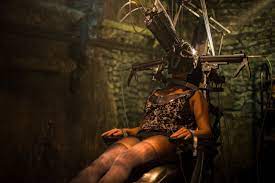
It’s the end-of-term art show at some kind of art college, and the students – having shown off their final pieces and had them duly drubbed by renowned critic Damian Self (Ronald Pickup) – are ready to party. I went to one of those shows once, and there wasn’t a notable person in sight. But hey, maybe that’s why they’re so keen to party, Self’s scathing comments notwithstanding. Perhaps their professor, Professor Leigh, just has that much pull. He is played by the wonderful Peter Davison, fifth and possibly best of the Doctors Who, after all.
All of this is told in flashback, as Melissa (Chelsea Edge) recounts to two police officers why she was found alive among a group of her dead fellow-students. This is not a spoiler, this is the first scene. As usual in this type of scenario, one of the officers (David Bamber) refuses to believe her, though this may be a ruse as he repeatedly demonstrates that he’s more interested in baiting Melissa into a philosophical debate about the definition of art than in getting to the bottom of things. Still, Melissa gets as far as explaining that all of this really has to do with a former student, Garth Stroman (Ivan Kaye), who got bored with conventional and even unconventional art and turned instead to murder. After all, don’t they always say, “cruciato ad veritatem” (pain [leads] to truth”)?
Well, no, I’ve never heard that saying either. But the movie tells me it’s so, so it’s so. Just like how artists from Roger Corman to David Bowie keep telling us that any artist sufficiently experimental will inevitably turn to murder. You won’t find anything in End of Term that you haven’t seen before, especially once we get to the horny teen party, and the teens start dying. Actually, the earlier scenes, mildly skewering the pretentions of young art students, are the best thing here. But the script isn’t bad, the whole thing is executed with a degree of style, and writer John Paul Chapple and director Mat Menony actually make good use of the structure of the film, which cuts between the police interview in the present and the events that got us to that point. Minus a couple of elements – a bafflingly unnecessary prologue with voiceover, and an unnecessary final twist that raises more questions than it answers – you’d have something pretty passable.