
The Film: ★★★★★
Death has been a constant theme in the films of David Cronenberg, but it may have been on the 80-year-old director’s mind more than usual of late. 2021 saw the odd little one-minute film “The Death of David Cronenberg”, in which the director, apparently playing himself, is able to tenderly kiss and hold a highly realistic dummy of his own corpse. His first feature since 2014’s Maps to the Stars finds him in similarly ruminative mood.
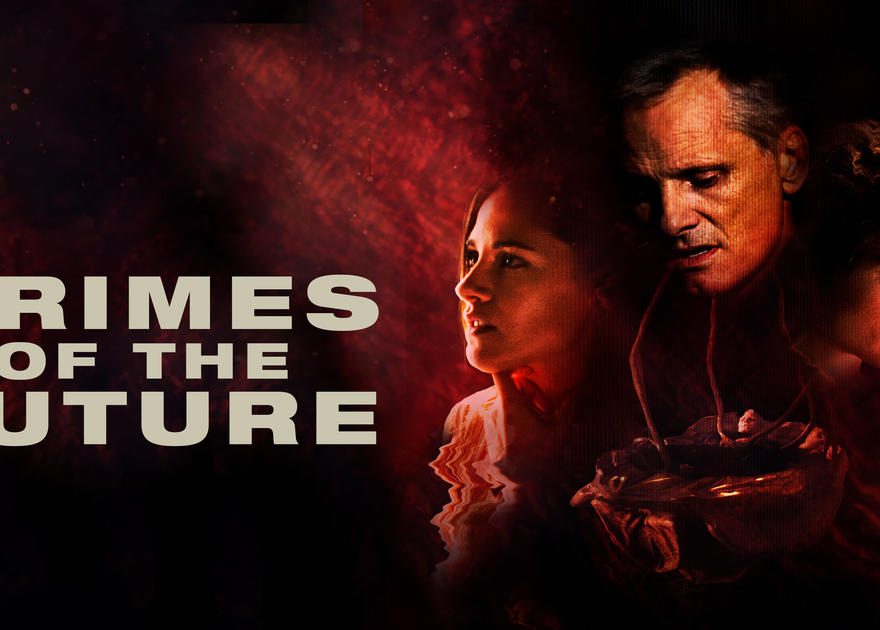
Crimes of the Future follows Saul Tenser (Viggo Mortensen), whose body spontaneously grows new, often mysterious, internal organs. Tenser has turned the surgical removal of these organs into a new form of performance art; meanwhile, there are a half-dozen other plot strands, covering a futuristic vice squad, an underground society of plastic-eaters, and much speculation on the future of food, sex, art, and just about everything else that makes life worthwhile. At its core, though, Crimes of the Future embraces the twin, intertwined themes of mortality and legacy. Tenser, old before his time due to his debilitating condition, reflects on the transformative power of his “organ art”. Cronenberg, who has become old the old-fashioned way (though, it must be said, appears much younger both physically and mentally), has made a return after several decades to the films of transformation and body organs that made his name. The parallels aren’t difficult to spot.
Cronenberg hasn’t made a film that we would really think of as “Cronenbergian” since 1999’s eXistenZ, and hasn’t really done body horror – in the gooey, transformative sense – since his 1986 masterpiece The Fly. Echoes of all the works that are most quintessentially him are on display in Crimes of the Future; even its title derives from an otherwise unrelated (and unremarkable) picture he made as a University of Toronto student in 1970. If the 2022 Crimes of the Future doesn’t quite transform our understanding of the human condition in the way that Videodrome, The Fly and Crash did, it’s probably because that’s an enormous ask for any film. As a postscript and a farewell to the body horror career from the undisputed and only master of the genre, it’s an embarrassment of riches. Of course, one hopes that Cronenberg has many more masterpieces still in him. But it’s hard to imagine him returning to the body horror well and coming up with anything this dignified, this solemnly beautiful and defiantly ugly, this bracingly strange yet strangely familiar.
Audio and visuals: ★★★★★
This is a spectacularly beautiful film – perhaps the most beautiful Cronenberg film yet – astonishingly, cinematographer Douglas Koch has never shot for Cronenberg before. The sound design is just as brilliant and carefully considered. This is a film that demands to be viewed in the highest def possible.
Presentation: ★★★☆☆
The big box contains, as is standard for this type of release from Second Sight, a set of art cards and a book of essays. The box art is attractive, though doesn’t quite convey the same creativity as the film itself. The menu, meanwhile, is serviceable, that’s all.
Extras: ★★★☆☆
Crimes of the Future‘s extras section kicks off with a commentary by Caelum Vatnsdal, scholar of Canadian horror films, who is full of information, yet relaxed and in an affectionately whimsical mood, gently poking fun at Crimes and Cronenberg’s peculiar fixations in general. Cronenberg himself gives a short, yet well-considered interview in gorgeous Greek surroundings in “Undeniably a Love Story”. He’s in a fine, thoughtful, and even optimistic mood, discussing the future of human biology, food supply, romantic relationships, and all the other themes you might anticipate. Viggo Mortensen appears in “Things Change”, apparently in a nearby room of the same hotel, to discuss his working relationship with Cronenberg – who had, in “Undeniably a Love Story”, already suggested that the two act more co-collaborators on various aspects of their films together (which include A History of Violence, Eastern Promises and A Dangerous Method), than a director and his star. Léa Seydoux, in stylish sunglasses and with a gorgeous sea view behind her, gets her turn in “The Chaos Inside”, while “The Heat and the Grime” features Kristen Stewart. Both speak enthusiastically (though briefly) about Cronenberg’s brilliance, Stewart giving an interesting take on the themes of Crimes and Cronenberg’s wider filmography. “The Bureau Man” features Don McKellar, who plays Wippet of the National Organ Registry in the film and, from the looks of it, didn’t get to go to Greece for shooting – his scenes all take place in a small, dark room, sadly for him. In “Painkiller”, which catches up with producer Robert Lantos, we learn that Crimes of the Future was originally entitled Painkillers – the script having been around since the late 90s and, much like George Miller’s Mad Max: Fury Road, has barely been altered since then. “The Most Wonderful Dream” and “The Code of David” are interviews with two other key members of the creative team: cinematographer Douglas Koch and editor Christopher Donaldson, respectively. After this extensive set of interviews, the next feature up is the video essay “New Flesh, Future Crimes: The Body and David Cronenberg”, which is short, yet useful for newcomers as it contextualises the aesthetic, erotic, and technological dimensions of Crimes of the Future in terms of Cronenberg’s wider filmography, paying particular attention to other body-transformation pics such as The Fly and Crash (unsurprisingly, oddities like the Stephen King adaptation The Dead Zone and the car movie Fast Company go unmentioned). The very short “The Making of Crimes of the Future” was included on the earlier, otherwise bare-bones release of Crimes of the Future, and so appears here too; while much of it is largely made redundant by the other features, it’s still worth a look nonetheless. Rounding things out are a gallery of production design materials, showing from the design process from 3D digital models to physical props, and the one-minute short film “The Death of David Cronenberg”, which is actually referenced in the aforementioned “New Flesh, Future Crimes: The Body and David Cronenberg”.
Overall: ★★★★★
With Crimes of the Future, Cronenberg hasn’t outdone anything he’s done before, but he has achieved a lovely, and strangely moving, synthesis of everything he’s done before, one which would make a fine postscript to his œuvre, should it end up being his last. This release belongs on the shelves of any aficionado of science fiction, horror, or art cinema generally.