
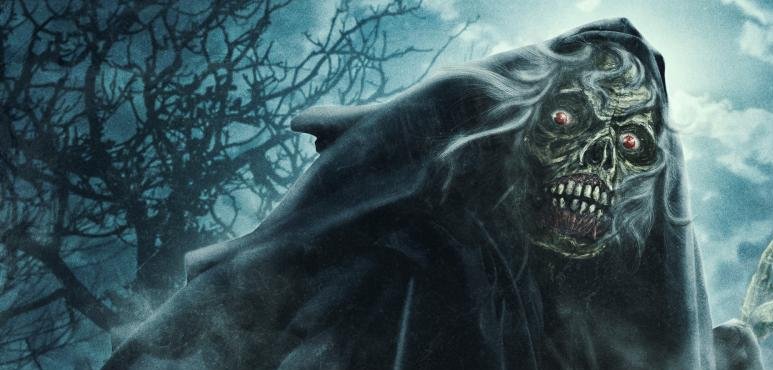
I’ve said it before, but while everyone is watching overwritten and overbudgeted streaming hits on Amazon Prime and Disney+ and Netflix and, apparently, Apple TV, Shudder has quietly become the best little streaming service out there. It’s reasonably priced, it’s accessible through Prime if you insist on doing things that way, it’s got a video player that actually works and a site that’s comfortable to navigate, and most importantly it understands its audience. Now I suppose, that’s of little relevance if you’re not a horror fan, but if you’re not a horror fan then I’m really not sure what you’re getting from reading this review.
Shudder cannily bought out the V/H/S series and turned it into their flaghsip film franchise; released on a one-a-year schedule, the series under Shudder has shown a considerable improvement in quality as well as quantity. Meanwhile, Creepshow – itself formerly a film series, bought out by Shudder – has become their TV equivalent, a tongue-in-cheek horror anthology and showcase for bad-taste splatter effects. Of course, I love it.
The original Creepshow, a dream-team collaboration between George A. Romero and Stephen King, was basically a love letter to the old EC Comics, Tales from the Crypt and its sister series. I’m not sure whether Creepshow was ever intended to actually be an official Tales adaptation, but essentially the only difference between the two is that Creepshow‘s host, the Creep, doesn’t talk while the Crypt Keeper never shuts up. The scrappy and fun little film, shot in fully kitsch comic-book style complete with panel transitions, solid-colour backgrounds and narration panels, was successful enough to warrant a sequel, but the IP soon ran out of steam. There were a couple of uninspiring revival attempts in the 20th Century, but it wasn’t until Shudder came along that the series was handled with any kind of understanding or respect for the source material. It helps that contributors to the series have included composer/Creepshow 2 director John Harrison, Stephen King’s son Joe Hill, and King himself. No doubt Romero would have been on board too had he been alive to see the show.
Instead, he gets to appear as a strange, Paperhouse-esque being animated from the pages of a (non-existent) zombie comic that he wrote, in Season 4’s best episode. Throughout its run, Creepshow has been at its best exploring meta-scenarios like that one; there’s the Season 2 episode where Justin Long enters the world of his favourite film, the unjustly forgotten Horror Express; or when Ted Raimi sells the Necronomicon on public access TV and causes Deadites to rampage through various shows.
The rest of S4 never quite hits the highs of that episode (entitled “George Romero in 3-D!”), and indeed suffers throughout from a noticeable downgrade in budget compared to previous seasons; there are no recognisable names on either side of the camera, unless you count directors John Harrison and Greg Nicotero (makeup effects wizard and Walking Dead producer, but he’ll always have a place in my heart for creating the Masters of Horror anthology series), but those two have been with the series all along so they hardly count. Sets seem cheaper, too, which isn’t a great problem in this highly constructed comic-book reality, but still, it’d be nice to see a locale more elaborate than somebody’s living room from time to time.
That’s not to say that there’s any shortage of the hysterically vile characters, loveable monsters, hideous gore and poetically nasty twist endings that have marked previous seasons, and there’s only one way to ensure the show gets the kind of budgets it deserves, which is to sign up and start streaming. That’s how these things live and die, and Creepshow and its parent service deserve a much longer life expectancy than the average character within Creepshow.