
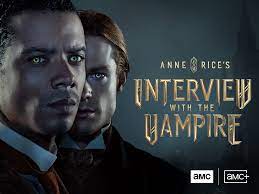
In a marketplace saturated with “shared universes”, AMC – presumably realising that their clockwork schedule of new Walking Dead spinoffs can’t be sustained indefinitely – announced in 2020 that they’d be developing adaptations of Anne Rice’s interlinked Vampire Chronicles and Mayfair Witches series, later given the rather hideous title of “The Immortal Universe”.
Naturally, the first television show to appear is based on Interview with the Vampire, the first, best-known and best-liked of the many books they could have picked from. The plot, in brief, sees journalist Daniel Molloy interviewing Louis de Pointe du Lac, a multicentenarian vampire, who recounts his life of decadence and debauchery, beginning with his encounter with the maddening Lestat de Lioncourt in old New Orleans. The immediate problem facing a producer of Interview with the Vampire for TV is that there’s already an extremely excellent, and enduringly popular, 1994 film of that novel. It’s a common fallback for new TV shows encountering this problem to signal an intent to treat the source material more faithfully than the prior adaptation, an especially convenient approach when the drawn-out nature of TV storytelling allows plenty of room for the sort of novelistic detail that films generally have to compress or cut. Even the admirable Lord of the Rings and Harry Potter films had to sacrifice most of the texture of those doorstopping novels just to make room for the huge amounts of plot contained therein.
And brother, Interview with the Vampire is a novel with texture by the bucketful. So it’s somewhat surprising that, despite the typical pre-release hot air by producers and writers, Interview the TV show shares only the loosest plot outline with Anne Rice’s novel. Predictably of course, the seaminess has been turned way up, but that’s not a problem in itself. There’s a lot of sublimated eroticism – especially homoeroticism – in Rice’s book, but zero real sex, because her vampires are, well, vampires. They can’t fuck, eat, booze it up or smoke cigarettes, while our TV vamps do almost nothing else. It really makes one wonder what their eternal ennui is really all about. Aside from the crampedness of their coffin-beds, it seems pretty idyllic.
Perhaps that’s why Lestat, who is the key character though not the main one, is so damnably chipper here. Sam Reid’s performance has been lauded, and rightly so. He’s magnetic, seductive, infuriating – to the point one feels bad for Jacob Anderson, theoretically the show’s star as the grounded, sensible, somewhat sympathetic and rather dull Louis – however, Reid is a far cry from the dull-eyed, affectless embodiment of malice seen in the novel. He’s at worst a little irascible, though certainly a better fit for the character than Tom Cruise was in 1994 (confusingly, Reid as Lestat bears a strong resemblance to Brad Pitt, that film’s Louis). Child vampire Claudia’s motives are also stripped of any sense they once made. With an adult’s mind in the eternally sexless body of a five-year-old monster, Claudia’s endless despair and rage is a horrific thing to contemplate, which remained true when the film aged her up so eleven-year-old Kirsten Dunst could take the part. Here, she’s aged up once again – the show tells us she’s fourteen at the time she’s turned, but shows us the 19-year-old Bailey Bass playing her. Bailey Bass gives an infectious performance too, oddly so – she jumps around the screen, babbles at a mile a minute, and does basically what she wants to do all the time, so the character’s angst at being treated as a paper doll by her vampire daddies comes from essentially nowhere. Sure, she’s been a teenager for a long time – it’s hard to say how long, because the show doesn’t give a good sense of time passing, and the anachronistic attitudes and dialogue don’t help – how often did people really say “fart-knocker” before Beavis and Butt-Head? – but we know it’s not more than a few decades, and I tend to think that staying young and pretty wouldn’t have become dull that quickly. Besides, when Claudia is given lines about how only a pervert would want her, I can’t help but feel awful for the beautiful, adult actress being made to deliver those lines – let alone any pervert romantic partner she might have. The producers didn’t even bother to make her look young the way Orphan: First Kill so brilliantly did with the now-26 Isabelle Fuhrman. Perhaps that’s why Bailey Bass has departed the show, but I don’t know. She does have a huge amount of Avatar sequels to film.
The only character change that’s been made here that really comes off is the show’s reimagining of Daniel Molloy, the interviewer. He’s barely a presence in the novel or the film, but here he’s played by Eric Bogosian as an ageing homosexual and former drug addict, delivering world-weary sarcasm and frequently puncturing Louis’ pretensions and attempts at self-justification (disappointingly, however, he has no response to the old “We’re not so different, you and I” routine, which ought really to have gone out the window when Dr. Evil attempted it in the first Austin Powers). Daniel’s really the show’s only likeable character, and uncoincidentally the only major human in the show; the producers, apparently noticing that Louis is neither a very compelling character, nor one it’s easy to side with – he’s a slaver and an only occasionally repentant murderer – have made Louis a twofer minority, a queer black man. Making the novel’s queer subtext into straightforward text isn’t much of a stretch, beyond the aforementioned oddity of giving the vampires working sexy bits, but the show claims to interrogate issues of race then proceeds to turn Louis – a character who, in the novel, is a slaveowner who at one point massacres those slaves to prevent an uprising – into a black man who owns a plantation in post-slavery Louisiana and…has no real thoughts about that. But he does kill a racist at one point, a moment that I presume we’re supposed to cheer for.
Now I’ve spoken a lot about the many ways in which the series misses the point of the novel, and just doesn’t live up to the film. But how does it fare in its own right? Well, there are some delightful N’Orlins accents and a variety of gorgeous ties on both men, the scenery’s handsome enough, in the bland, glossy and CG-heavy style of pretty much any period production from the last couple of decades, and there’s plenty of the steaminess and violence you might expect from AMC, “the wannabe HBO”. But the show’s essential callousness makes it difficult to get invested. You don’t need to like Louis, Lestat or Claudia for the narrative to be compelling: as a matter of fact, you probably shouldn’t like them. But the writers give the distinct impression of being terrified of audiences failing to connect, so their vampires are made all shiny and woobie-ish, and this in turn means – as in Twilight – minimising the importance of any human character, since treating humans as cattle is kinda vampires’ whole deal, y’know? The show is so busy trying to convince us that its vampires aren’t callous monsters that the show itself becomes callous. I’m reminded of the quandary faced by Daniel Craig’s Bond films: in the 21st Century, the desire was to depict a sexist 007 without the films themselves being sexist, but they got it backwards and ended up still making sexist films, but starring an unsexist agent. As Molloy notes, “Once you put it out there, they decide what it is. It can get away from you.” He was discussing the prospect of sexy Claudia-inspired Halloween costumes, but he could just as well be describing the whole franchise in its iterative re-imaginings from the original novel, through the sequel novels to the film and now the series. The novel gives us a sort of overheated Southern Gothic decadence that’s rotten to the core, but the show instead luxuriates in it, and ends up feeling just as hollow as the very sham opulence it depicts. The viewer might feel as much ennui as the vampires do, and that’s a problem. I’ve made unfavourable comparisons to the book and film enough here, so I’ll say this instead: it is possible to do vampiric Weltschmerz without leaving the viewer equally burned out. Two excellent examples are Jim Jarmusch’s Only Lovers Left Alive and Abel Ferrara’s The Addiction.
Still though, it probably is worth sticking around for the second season – despite the less-than-favourable responses to Mayfair Witches, the second “Immortal Universe” (ugh!) TV series – because there’s a rather clever metafictional twist on the story that gives almost unlimited leeway for correcting these problems. See, this isn’t Molloy’s first Interview with the Vampire. He’s supposed to have done the original interview in San Francisco in 1976 – uncoincidentally, the setting and year of the novel. Now, as a much older man, he’s catching up with an un-aged Louis in Dubai – because if sunlight killed you, where better to move to than Dubai, eh? In any case, Louis in this second interview demonstrates a self-serving memory and frequently leaves us wondering how much what we’re being shown resembles the way things “truly” went down. It’s a fascinating conceit and one that could really serve the show well in future seasons, assuming the “Immortal Universe” (yuck!) sticks around long enough to finish adapting the book.
★★☆☆☆